INTERNATIONAL RESEARCH PROJECT · IASSW & EASSW JOINT RESEARCH GRANT 2026
Poverty in Central and Southeast Europe: Social Policy and Social Work Responses


FUNDED BY
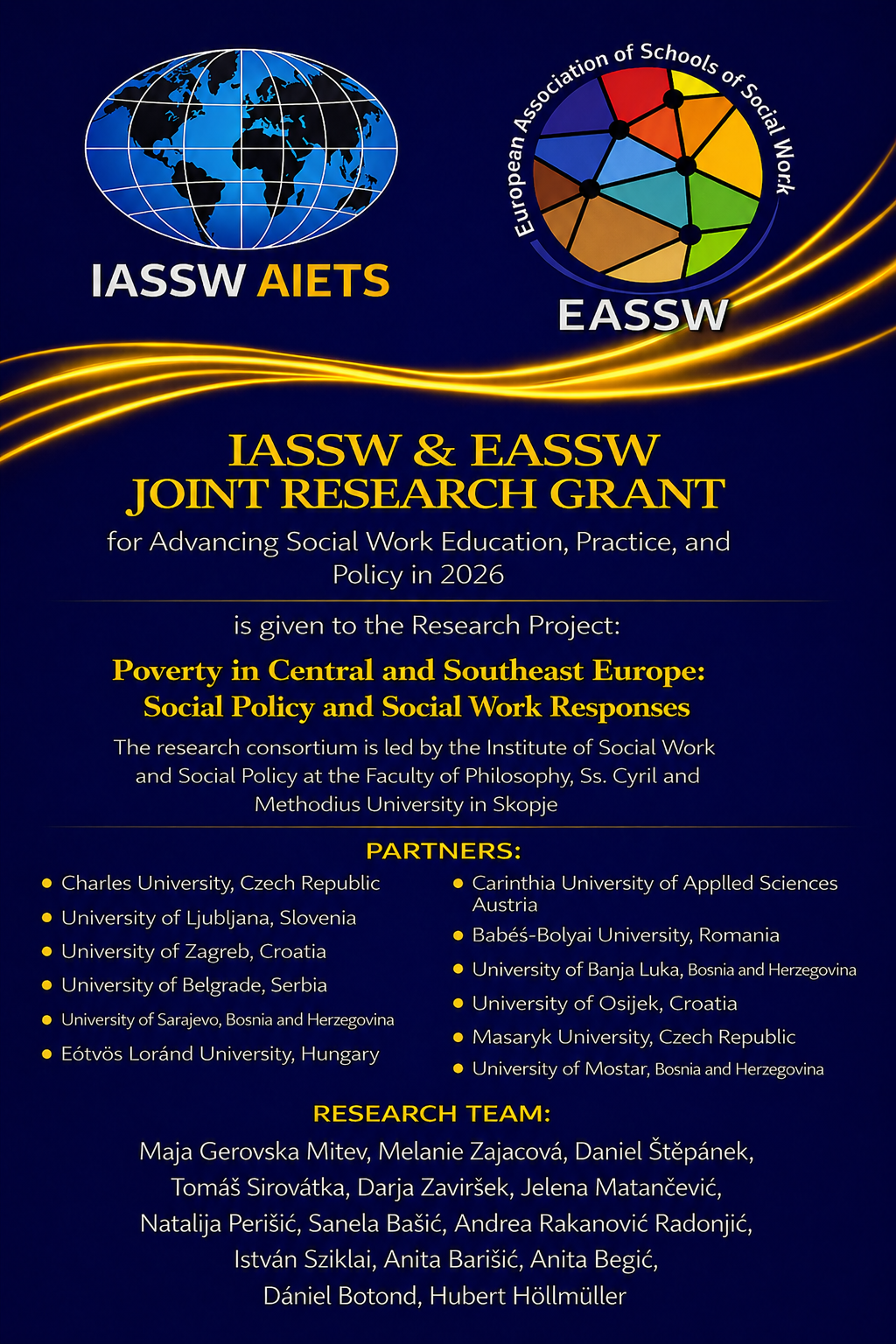
IASSW & EASSW Joint Research Grant 2026
COORDINATOR
Institute of Social Work and Social Policy, Faculty of Philosophy, Ss. Cyril and Methodius University in Skopje
PROJECT LEAD
Prof. Maja Gerovska Mitev
DURATION
02.05.2026 – 02.05.2028
Project in numbers
9
countries
13
universities
24
months
Partner countries
 North Macedonia
 Austria
 Czech Republic
 Slovenia
 Croatia
 Serbia
 Bosnia and Herzegovina
 Hungary
 RomaniaNorth MacedoniaAustriaCzech RepublicSloveniaCroatiaSerbiaBosnia and HerzegovinaHungaryRomania
About the project
This collaborative research project investigates the complex and multidimensional nature of poverty and the corresponding social policy and social work responses in Central and Southeast Europe (CSEE). The CSEE region is analysed in the context of nine countries, including: Austria, Czech Republic, Hungary, Slovenia, Croatia, Romania, Serbia, North Macedonia and Bosnia and Herzegovina. Despite constituting a distinct region, these countries are rarely analysed together in a comparative framework and most of them have remained on the periphery of both social work and social policy scholarship. Our project aims to systematically analyse if and what type(s) of welfare states are emerging in CSEE, moving beyond established Western typologies. We will use anti-poverty policies and frontline social work practices as key analytical lenses. Through examination of the interaction of social (anti-poverty) policies and social work we will assess whether they are effective in their synergies at the frontline.
By bringing together a multinational team of researchers from 13 institutions across 9 countries, the project will identify common features, while also mapping the significant differences and sub-types across national contexts. The primary innovative contribution of this research is the potential to de-center Western social science and generate a new, empirically grounded theory of welfare states from a historically marginalized region. It does so not just by looking at policies, but by understanding them through the critical, ground-level lens of social work practice. The findings will strengthen the evidence base for poverty in CSEE and contribute to more nuanced and progressive social policies and social work in this European region.
Objectives
01
Advancing social work education and research across the diverse cultural and regional contexts of CSEE, creating a robust comparative knowledge base.
The majority of the analysed countries in this project share a complex history of post-socialist transition (except for Austria). All of them, however, have grown in different political, economic, and cultural circumstances, which motivates our scientific curiosity to map the distinctiveness of these paths. At present, the education of social work and social policy in the region is based on theories and models from Western welfare states, which may not fully reflect the realities and complexities of the area. This project directly fills this gap by creating knowledge that is specific to the CSEE experience. The project aims to construct grounded theory, empowering and providing theoretical representation to a region marginalised in academic discourse.
We will create a systematic and strong comparative knowledge base by using a structured, collaborative approach. This will allow for a nuanced understanding of how social policy and social work is conceptualized and practiced in these CSEE countries, thus providing educators with concrete, regionally relevant case studies and data to enrich their curricula, moving beyond a one-size-fits-all approach. Along with the case studies approach, a comparative analysis will be conducted in order to point to both similarities and differences in social policy and social work approaches to poverty. This will also serve future social policy and social work scholars in CSEE with analytical tools and practice models that are both globally informed and locally grounded. Consequently, the project aims to elevate the profile of CSEE as a vital and productive region for critical social policy and social work scholarship.
02
Promoting equity, inclusion, and social justice by critically examining how welfare systems and social work practices either alleviate or perpetuate poverty and exclusion.
A core mission of social work is to challenge systemic inequalities and advocate for a more just society. This project operationalizes this mission by conducting a critical examination of the very systems designed to provide support. We will investigate how the design of anti-poverty policies, such as eligibility criteria, benefit levels, and conditionalities can inadvertently create barriers, produce discriminatory and disciplinary practices and exclude the most marginalized groups, including the Roma population, rural communities, migrants, victims of violence against women and in families and people with disabilities.
Furthermore, the research will scrutinize social work practices at the frontline, analysing how professional discretion, resource constraints, institutional biases and finally new technologies can either empower clients or reinforce their stigmatization. By exploring how inclusion and exclusion play out in different countries, we can spot both the harmful ways systems can leave people out and the creative, fair practices that make a difference. Looking at things critically helps us shift from focusing on what is missing to recognizing and advocating for people’s rights. Our project is not just about analysing these patterns; it is about creating a practical guide that helps everyday people, communities, and advocates push for social welfare systems that are truly fair and inclusive.
03
Addressing pressing global challenges, primarily social justice and human rights, by focusing on the lived experience of poverty and the efficacy of systems designed to support vulnerable populations.
By employing qualitative methods to capture the lived experiences of poverty, the project will assess the efficacy of social protection systems not by bureaucratic metrics alone, but by whether they truly uphold human dignity, security, and the right to participation. Centred on the human rights imperative inherent to social work, this project scrutinizes the systemic barriers that impede pathways out of poverty. It specifically explores how intersecting adversities, including for example the precarious status of economic migrants and the marginalization wrought by ethnic discrimination, create cycles of disadvantage. The empirical analysis will identify the existing resilience factors as well as the notable shortcomings within the current support infrastructure.
04
Strengthening the evidence base for social work education, policy, and practice by producing empirically grounded analyses of welfare state configurations and their outcomes, which can directly inform curriculum development and policy advocacy.
A primary objective of this project is to develop an evidence-informed resource in the form of a collaborative publication, intended to serve as a foundational textbook for social work and social policy curricula across the CSEE region. This volume will bring together our empirical analysis of various welfare state models and their outcomes, offering students and educators a contextually relevant perspective that moves beyond Western-centric frameworks. At the same time, the publication will function as a practical tool for policy advocacy and reform, grounded in solid evidence.
Our comparative findings will provide policymakers, government officials, and non-governmental organizations with updated insights into what strategies are effective, which are not, and the reasons behind these outcomes in anti-poverty initiatives. The research is designed to serve both educational and policy goals. It aspires to connect academic insights, professional training, and practical policy efforts, all to help develop more effective and responsive welfare systems in the region.
SPECIFIC RESEARCH OBJECTIVES
1. To develop a comprehensive overview of the main policies and approaches used to fight poverty and deliver social services throughout the CSEE region.
2. To examine existing anti-poverty policies and social work practices using welfare state theory, allowing us to identify common regional trends as well as distinctive national differences.
3. To investigate the roles, challenges, and innovative practices of social workers involved in the implementation of these policies and their direct efforts to combat poverty.
4. To explore the (dis)harmony between anti-poverty policies and social work and how the broader social policy frame enhances the efforts of social workers in social inclusion of marginalised groups.
5. To create an analytical framework that facilitates comparative analysis while allowing flexibility to focus on country-specific issues, such as Roma inclusion, rural poverty experiences, or post-conflict recovery.
6. To effectively disseminate the research findings to academic, policy, and practitioner audiences, thereby influencing social work education and advocating for more effective, rights-based social policies.
Methodology
The project employs a mixed-methods, comparative case study design over 24 months.
MONTHS 1–6
Desk-based analysis and framework development
Collaborative development of a unified analytical template, with indicators for welfare state analysis (benefit generosity, coverage, conditionality) and social work practice (discretion, ethical challenges, community-based work, new technologies), as well as discourse analysis. Each national team conducts a systematic review of literature, policy documents and existing data on poverty.
MONTHS 7–14
Empirical data collection
Using the common template, each partner leads data collection in their national context: critical discourse analysis of key anti-poverty strategies and legislation and, where relevant, semi-structured interviews with practitioners, policy makers and NGO representatives and focus groups with beneficiaries.
MONTHS 15–20
Synthesis, analysis and writing
Cross-national comparative analysis workshops to identify patterns, divergences and sub-types, and collaborative writing of the joint publications.
MONTHS 21–24
Dissemination
Active dissemination of findings through the joint publications, joint events and presentations at international conferences (e.g. EASSW, IASSW, ESPAnet).
Project timeline
13 Oct 2026
15–17 Feb 2027
April 2028
Research outputs
OUTPUT 1 · SPECIAL ISSUE
Special issue accepted by an international peer-reviewed journal
The proposal for a special issue under the project title was accepted in July 2026, with Prof. Maja Gerovska Mitev as guest editor. The papers will be submitted in December 2026 – January 2027 and, after the peer-review process during 2027, the special issue is expected to be published in March 2028.
Each country paper follows a harmonised conceptual approach, focusing on poverty discourses, measurement and trends; policy frameworks and social protection; and frontline implementation and street-level practice.
OUTPUT 2 · COMPARATIVE BOOK
Poverty in Central and Southeast Europe: Social Policy and Social Work Responses
The book is in preparation, to be published by a renowned international publisher. The chapters will be discussed at the regional meeting in Skopje (15–17 February 2027) and the manuscript will be delivered to the publisher in September 2027.
OUTPUT 3 · INTERNATIONAL CONFERENCE
International conference in North Macedonia, April 2028
The results of the project will be presented and promoted at a joint international conference in North Macedonia.
Activities
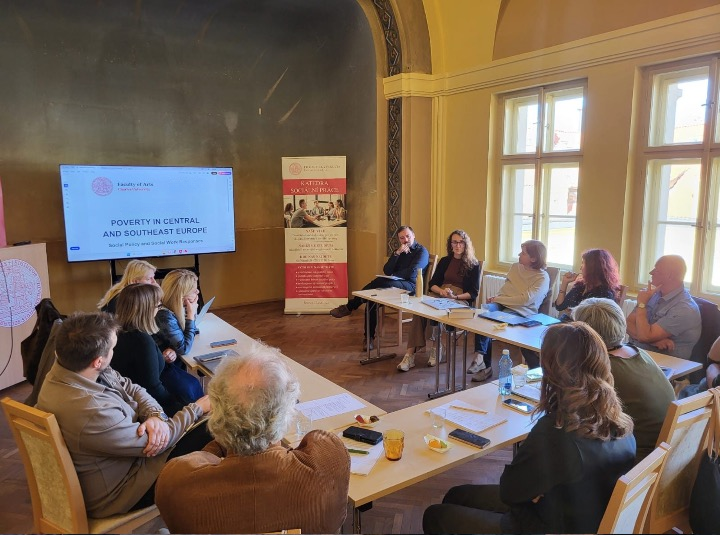
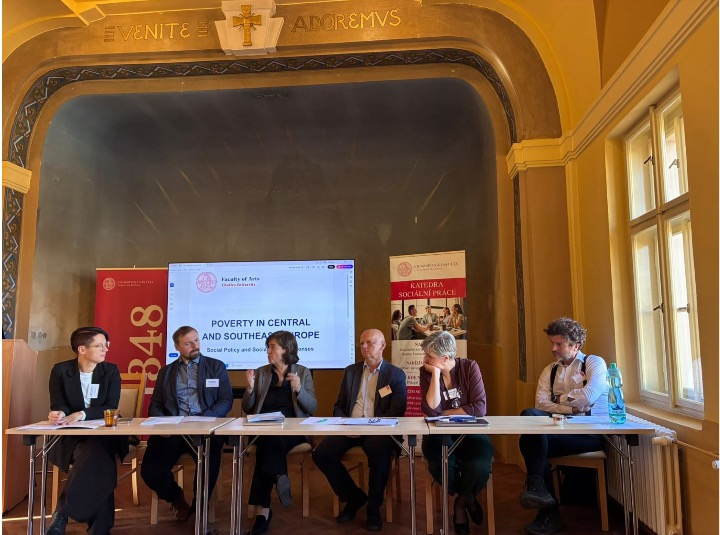
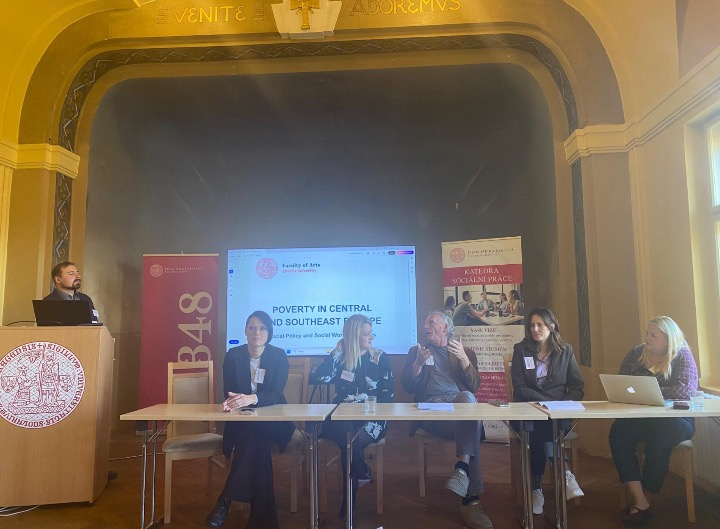
13 OCTOBER 2026 · PRAGUE
Round table on the country papers
The draft country papers were presented and discussed at two round tables held at the Faculty of Arts, Charles University in Prague.
Poverty and Social Policy Responses in Central and South East Europe: Tomáš Sirovátka, Jelena Matančević, Maja Gerovska Mitev, Natalija Perišić, Daniel Štěpánek
Poverty and Social Work Responses in Central and South East Europe: Melanie Zajacová, Hubert Höllmüller, Andrea Rakanović Radonjić, Anita Barišić, Anita Begić
15–17 FEBRUARY 2027 · SKOPJE
Regional meeting on the comparative book
The project team will meet in Skopje to discuss the chapters of the comparative book.
Research team
NORTH MACEDONIA · COORDINATOR
Maja Gerovska Mitev
Ss. Cyril and Methodius University in Skopje
AUSTRIA
Hubert Höllmüller
Carinthia University of Applied Sciences
CZECH REPUBLIC
Melanie Zajacová, Daniel Štěpánek
Tomáš Sirovátka
Charles University
Masaryk University
SLOVENIA
Darja Zaviršek
University of Ljubljana
CROATIA
Jelena Matančević
Anita Barišić
University of Zagreb
Josip Juraj Strossmayer University of Osijek
SERBIA
Natalija Perišić
University of Belgrade
BOSNIA AND HERZEGOVINA
Sanela Bašić
Andrea Rakanović Radonjić
Anita Begić
University of Sarajevo
University of Banja Luka
University of Mostar
HUNGARY
István Sziklai
Eötvös Loránd University
ROMANIA
Dániel Botond
Babeș-Bolyai University
This project is funded by the IASSW & EASSW Joint Research Grant for Advancing Social Work Education, Practice and Policy in 2026.
International Association of Schools of Social Work (IASSW) and European Association of Schools of Social Work (EASSW).